Flickering lights is one of the most common calls we get in Berkeley. People describe it a bunch of different ways. The lights dim for a second when the fridge kicks on. The whole room flickers when you run the microwave. One person told me their lights flicker every time they plug in a phone charger, like the house has a ghost. Different symptoms, and they don't all mean the same thing.
Here's the thing to understand up front. A little flicker once in a blue moon usually isn't an emergency. But flickering that keeps happening, or is getting worse, or happens across the whole house at once, is your electrical system trying to tell you something. In an older Berkeley home, it's worth paying attention to.
When one light flickers
If it's a single fixture or one room, the problem is usually close by. A loose bulb, a worn-out switch, or a loose connection at the fixture. In older homes the switches and outlets can be decades old, and the connections inside them loosen up over time. That's a smaller fix, but a loose connection is also exactly the kind of thing that can heat up, so it's not something I'd ignore forever.
When the lights dim as something turns on
This is the classic one. You start the microwave or the AC, and the lights dip for a second. What's happening is a big appliance pulling a lot of current all at once, and the wiring can't quite keep up. In a lot of older Berkeley homes the circuits were sized for a 1940s or 1950s house, not for everything we plug in today. Sometimes it means a circuit is overloaded. Sometimes it points back to the panel. Either way, it's the house telling you the electrical system is working harder than it was built for.
When the whole house flickers
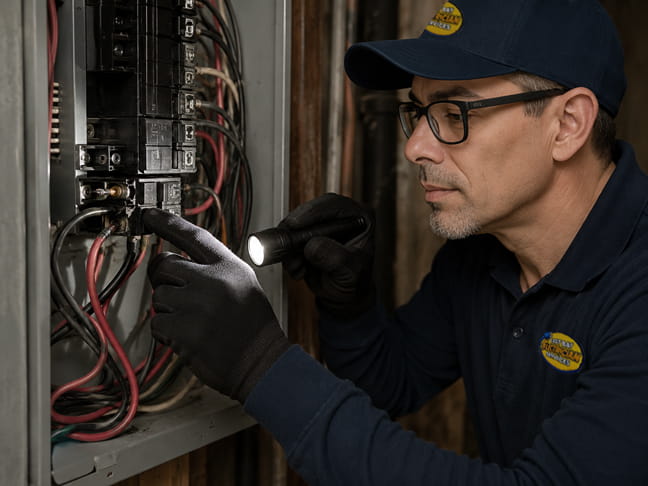
This is the one I pay the most attention to. If lights all over the house flicker at the same time, or you see it happening at the panel, that can mean a loose or failing connection at the main panel or where the service comes into the house. That's not a DIY situation and it's not something to sit on. A bad main connection can arc and overheat, and that's a fire risk. When somebody describes whole-house flickering, I want to get out there and look.
What an electrician actually checks
When I come out for flickering, I'm tracing it back to the source instead of guessing. I check the connections at the affected fixtures and switches, look at the circuit that's acting up and whether it's overloaded, and open the panel to check the breakers and the main connections. In older homes I'm also looking at the age and condition of the wiring itself, because sometimes flickering is the first sign that the wiring is past its life. The point is to find the actual cause, not just swap a bulb and hope.
Lights flickering in your Berkeley home?
I'm Matt, owner of East Bay Electrician Services. If the flickering keeps happening, is getting worse, or hits the whole house at once, that's worth a look. Tell me what you're seeing and when it happens and I can usually get a sense of what's going on before I even get there.
If you need a Berkeley electrician to track down flickering lights, call me at (510) 467-0856. If it traces back to your panel, here's more on our electrical panel work.
📞 Call (510) 467-0856